For most people with a missing tooth, healthy gums and a long time horizon, an implant is worth it: it is the only option that protects the jawbone, leaves the neighboring teeth alone and does not put you on a replacement cycle. A bridge or partial can still be the better choice in some cases, and an exam tells you which.
- The three options for a missing tooth are an implant, a bridge and a partial denture.
- A bridge needs the two neighboring teeth shaved down for crowns. An implant stands on its own.
- Only an implant keeps stimulating the jawbone under the missing tooth.
- A higher price up front can cost less over the years once replacements are counted.
- If the neighboring teeth already need crowns, a bridge can be the smarter choice.
There is a specific moment when this question gets asked in our Reseda office. The exam is done, the options are on the table, and the patient looks up and says some version of: okay, but honestly, is the implant actually worth it, or am I paying extra for the fancy option?
It deserves an honest answer, not a brochure answer. An implant usually costs more up front than a bridge and much more than a partial denture, and for some patients one of those alternatives genuinely is the smarter call. So instead of cheerleading, let us do what we would do chairside with a neighbor from Winnetka or Canoga Park: put all three options on the table, compare them on the things that matter over ten and twenty years, and give you a framework for deciding, not a sales script.
Weighing your options right now? Bring us your questions. Call our Reseda office at (818) 343-4024 and we will lay out every option for your specific tooth, including the ones that cost less.
- The Three Ways to Replace a Missing Tooth
- Comparison One: What Each Option Asks of Your Other Teeth
- Comparison Two: The Bone Question
- Comparison Three: Lifespan and the Replacement Cycle
- Comparison Four: Daily Life
- When an Implant Is Probably Not the Right Call
- A Simple Decision Framework
- So, Worth It?
- Frequently asked questions
The Three Ways to Replace a Missing Tooth
For a single missing tooth, modern dentistry gives you three real choices.
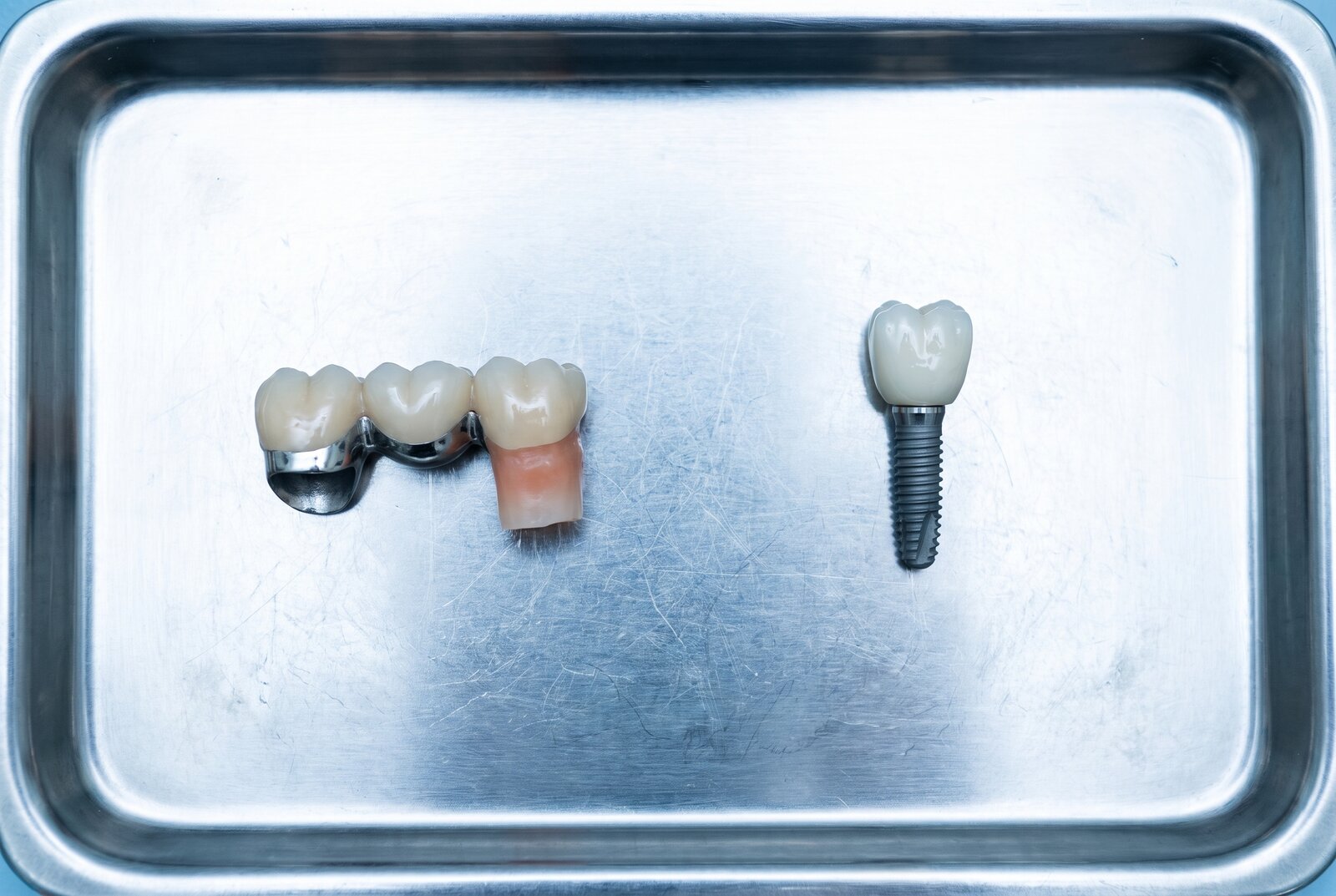
- A dental implant. A titanium post placed in the bone with a ceramic crown on top. A standalone new tooth that touches nothing around it. Our implant services page covers the details, and if you want the mechanics explained first, start with what dental implants are and how they work.
- A fixed bridge. The two teeth beside the gap are reshaped and crowned, and a connected false tooth spans the space between them. Fixed in place, no surgery involved.
- A removable partial denture. A replacement tooth on a gum colored base that clasps onto neighboring teeth and comes out at night. The most affordable path, covered in depth on our dentures page.
All three give you a tooth shaped object in the gap. What separates them is what happens to everything around that gap over the following decades.
Comparison One: What Each Option Asks of Your Other Teeth
This is the comparison patients hear about least often, and it might be the most important one.
A bridge cannot exist without support, and its support is your two neighboring teeth. To crown them, healthy enamel has to be shaved away, permanently. If those teeth are already heavily filled or crowned, that is no sacrifice at all, and a bridge becomes very attractive. But grinding down two untouched, healthy teeth to fix a problem they did not cause is a real cost that never appears on the invoice. Those support teeth also now share all the chewing load of three teeth between two roots, and if one of them fails someday, the whole bridge fails with it.
A partial denture is gentler but not free of consequences. Its clasps grip neighboring teeth and rock against them a little with every bite, year after year.
An implant asks nothing of your other teeth. It brings its own root. The neighbors stay untouched, keep their own workload, and fail or survive on their own merits. Dentists tend to feel strongly about this one because we spend our careers watching what load and drilling do to teeth over decades.
Comparison Two: The Bone Question
Under every missing tooth, a quiet process is running. Jawbone maintains itself in response to chewing forces delivered through tooth roots, and where there is no root, the bone slowly shrinks. A bridge and a partial sit above this process and do not slow it down. Over many years the gum under a bridge can visibly hollow out, and partial wearers often notice their appliance needing relines as the ridge changes shape.
Because an implant is anchored in the bone and delivers chewing force into it, it keeps that patch of jaw in active service. This is also a timing argument: implants are simplest and cheapest to place while the bone is still plentiful. Waiting years with a gap, or under a partial, can mean needing a graft later to make an implant possible at all. We cover how that affects pricing in our guide to implant costs in Reseda.

Comparison Three: Lifespan and the Replacement Cycle
Here is where the up front price comparison starts to invert.
A well made bridge is a good restoration, but it lives under heavy load and its fate is tied to two support teeth. Bridges commonly serve for many years and then need replacement, often because decay crept under a crown edge or a support tooth gave out. Each replacement is a new round of cost, and sometimes the second bridge needs to be longer than the first.
Partial dentures wear, loosen and need relines or remakes as the mouth changes under them. They are the cheapest option every single time you buy one, and you buy them more than once.
An integrated implant fixture is the closest thing dentistry has to a permanent part. With healthy gums and decent hygiene, the post in the bone can serve for decades and frequently for life. The crown on top may need replacement eventually, as any crown might, but that is a far smaller job than redoing a bridge. Spread across twenty years, the implant is very often the cheapest tooth in the race, which is a strange sentence to write about the most expensive option on day one.
Comparison Four: Daily Life
Some differences only show up at breakfast. A partial denture comes out at night, needs cleaning routines of its own, and has a learning curve for speech and certain foods. A bridge stays put and chews well, but flossing under it requires threaders or a water flosser, forever, and skipping that chore is how bridges are lost. An implant is brushed and flossed like the tooth it replaced, holds nothing back at the dinner table, and involves no adhesives, soaking cups or special tools. Patients stop thinking about it, which is perhaps the highest compliment a false tooth can earn.
There is a quieter daily life factor too: confidence. Partial wearers tell us they plan around their appliance, skipping certain foods at restaurants on Sherman Way or worrying about it shifting mid sentence in a meeting. That low grade background attention is hard to put on a price sheet, but ask anyone who has switched from a removable appliance to an implant which one they would go back to. We have yet to hear anyone vote for the soaking cup.

When an Implant Is Probably Not the Right Call
An honest look has to include this list. An implant may not be your best move when:
- The neighboring teeth already need crowns anyway. A bridge then fixes three problems with one restoration, and it is a genuinely elegant solution.
- Uncontrolled gum disease or health issues make surgical healing unreliable. Stabilize first, decide after.
- Heavy smoking is in the picture and quitting is not. The odds shift against osseointegration.
- The budget simply is not there right now, even with financing and phasing. A well made partial from our denture options preserves the space respectably while you plan, and an extraction site can often receive an implant years later.
- The tooth might still be savable. Replacing a tooth that root canal therapy could keep is skipping a step. Keeping your own tooth, when the long term outlook is good, beats every replacement ever invented.

A Simple Decision Framework
Strip away the dentistry and the decision usually comes down to four questions.
- What condition are the neighboring teeth in? Untouched and healthy favors an implant. Already crowned or heavily filled opens the door to a bridge.
- What is your time horizon? The longer you plan to use this tooth, the more the math tilts toward the implant.
- Can you maintain it? Every option requires hygiene, but a bridge demands a specific daily flossing routine. Be honest with yourself here.
- What does your mouth allow? Bone volume, gum health and bite forces are facts, not preferences. A scan settles them quickly.
If you land on the implant side, our walkthrough of the implant process from consultation to final crown shows exactly what the road looks like, visit by visit. And if the failing tooth is still in place, the journey may begin with a tooth extraction, which changes the sequencing but not the destination.
So, Worth It?
For most patients with a missing tooth, healthy gums and a long time horizon, yes, and not by a small margin. The implant is the only option that protects the bone, spares the neighboring teeth and does not put you on a replacement cycle. For some patients, a bridge or partial is legitimately the wiser choice, and we place plenty of both without apology. The point is that this is a decision to make with your own x rays in front of you, not a comment section.
Families across Reseda, Tarzana, Northridge and the wider San Fernando Valley come to us for exactly that conversation. Call (818) 343-4024 or visit our contact page and we will help you run your own numbers, on your own teeth.
Frequently asked questions
Are dental implants worth the money?
For most people with a missing tooth, healthy gums and a long time horizon, yes. An implant protects the jawbone, leaves the neighboring teeth untouched and is not on a replacement cycle, so it often costs less over the long run.
Is a bridge cheaper than an implant?
A bridge usually costs less up front. Over time the comparison can flip, because a bridge depends on two support teeth and may need replacing, while a healed implant post can last for decades.
How long do dental implants last?
The titanium post can last for decades and often for life with good care. The crown on top does the chewing and may need replacing someday, like any crown.
When is an implant not the right choice?
When the neighboring teeth already need crowns, when gum disease or a health condition is not under control, or when you need a faster or less expensive solution. A bridge or partial can be the better fit in those cases.
Does a missing tooth really cause bone loss?
Yes. Jawbone stays healthy through the chewing forces that travel through tooth roots. Where there is no root, the bone slowly shrinks. An implant is the only replacement that keeps that stimulation going.
Sources: ADA MouthHealthy: Dental Implants. This article is general information, not a diagnosis. Your dentist can tell you what fits your own teeth.